Tongan DVD of Comedy Concert
The name ‘Potolahi Productions’ was a way to give my early experiments in video in Tonga a little more tongue in cheek and cultural credibility. The first production was a double dvd set featuring five skits of a Tinitini Concert in Falaleu, Vava’u that I had fortuitously filmed in November 1999.
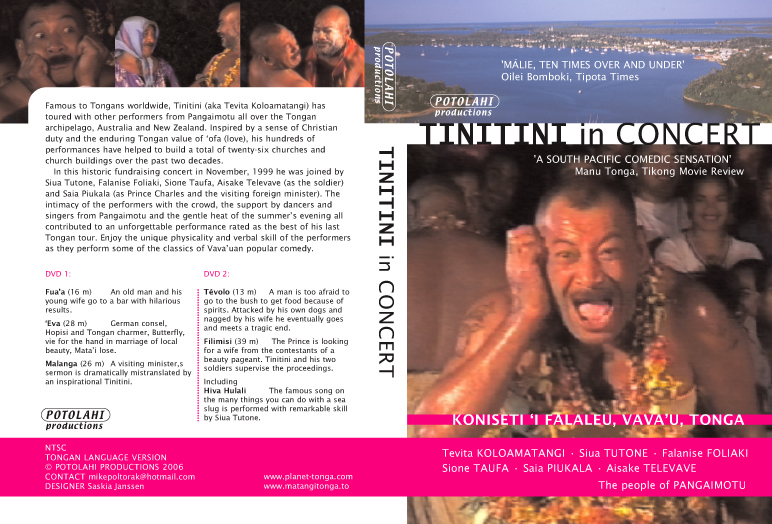
That DVD developed into a bigger documentary project on Tongan comedy.
Documentary on Tongan Comedy
My original blog aimed to communicate the history and development of the documentary film, Fun(d)raising: A Secret of Tongan Comedy.
The first version named ‘Hange ha Kuli Viku: Like a Wet Dog’ was shown in Nuku’alofa, Tonga on the 12th July 2007 as part of the Tongan Research Association conference. The title was based on what I thought was a commonly known proverb ‘Hange ha Kuli Viku’ that communicated something really hilarious. After the screening, I realised that the proverb was not as widely used as I imagined, and some people took issue with the literal association of Tinitini with a wet dog. I decided not to try to be too clever in Tonganising the titles, and called it Fun(d)raising.
Several weeks later we screened at the Paradise Hotel, Neiafu. We discovered on arriving in Vava’u that Siua Tutone (also known as Moala Lahi) and the star of many fundraising concerts with Tinitini, was in hospital to have his leg amputated because of diabetes. So we went to Ngu hospital and in the company of a full ward showed Siua the documentary. He was moved, we were moved and all the patients in the hospital who watched the film felt uplifted by both the humour and the realisation of the great Christian dedication Siua had shown to fundraising to build churches and to support his family.
The whole experience made me think about the many ways comedy and health interact. Comedy makes us feel better about our common humanity, it links us together in celebrating and dealing with the difficult and ridiculous aspects of life. How though could we use comedy to protect people from suffering in the way Siua has ? Could we use a documentary on Fundraising to fund raise for a new prosthetic leg for Siua? Is it possible to use comedy to do more effective health promotion.
The first stage was to submit the film to several film festivals around the world to get wider recognition for comedy in Tonga. It was submitted to DOCNZ in Auckland in February, 2009, to LIDF (London) and the Comedy Film Festival (Toronto). Unfortunately, the film was not accepted at any of these festivals.
Before we had an opportunity to raise money for Siua’s new leg, we learned that he had died in hospital from of complications of diabetes. This was a tragedy that shook me to the core, and made me feel even more to celebrate in some form of eulogy, the great work that Siua Tutone had done.
So in 2009 I returned with a plan to make a documentary that would look into the wider reasons why Siua Tutone had died of diabetes. I felt that perhaps his story could inspire others to seek diagnosis early, or help in better understanding the maintenance of the condition. In discussion with Tevita and Pote on my return, I realised that drawing attention to Siua’s death, was not the best way in Tonga to do health promotion at this time. So we agreed to work on a project to produce a combination of skit and song, to communicate the difficulties of diabetes in a more humorous way. We made a few short videos to update people on Tevita’s fundraising. The below draws attention to the school bus that his fundraising helped to fund.
From Diabetes to Mental Illness
In April 2011 I returned to Tonga to continue this project. However, on arriving I had to reconsider our earlier plans. Tevita had moved to Tongatapu and was not available to film in Vava’u. In conversation with a good friend in Vava’u I looked at producing another film that would address issues of health but do it in a more ethnographic and observational style, and would build on my long term friendship with one of the most well known healers in Vava’u and the Psychiatrist Dr Mapa Puloka. Emeline and I had worked together for many years. I proposed to film her and her family for several weeks and gather testimonials from previous patients and in the process build an understanding of her healing. One questoin was why people go to the hospital or seek traditional medicine? Then the plan was to set up a form of video dialogue with Dr Puloka, and see where their treatments and understandings of mental illness were similar or different.
The process of filming raised many interesting issues. On one Saturday morning, I followed Emeline around Neiafu, as she met people and we filmed their testimonials. Many interesting stories and connections were made. Also at the time I learned that Tevita, Emeline’s husband was bed bound with a knee infection. He had been in hospital for several months and had seemingly not got better and so had checked himself out. I filmed his inflamed knee and the pus seeping from it, and showed it to the doctor at the hospital. He very helpfully checked Tevita’s medical record, and explained to Tevita on video what precisely was wrong with him. That process led to the doctor sending a health officer to check him out at home, and also persuaded Tevita to be readmitted to hospital. He tearfully recognised, that this was the first time that a doctor had explained to him so clearly what he had. A week later, as I was returning to the UK, I learned he had been successfully treated in the hospital.
The resulting documentary, called the Healer and the Psychiatrist, has been completed.
 Potolahi Productions